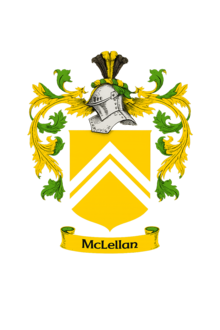
News, stories and updates for the Mc Lellan family across South Africa.
"Think On"
Our Story
Clan MacLellan is a Lowland Scottish clan rooted in Galloway, southwest Scotland — the Stewartry of Kirkcudbright. The village of Balmaclellan and the iconic MacLellan's Castle (built ~1577) bear the family name to this day. The clan motto "Think On" dates to the 1450s, when Sir William MacLellan presented a bandit's head to King James II on the tip of his sword as a reminder of his family's loyalty.
Scots began settling South Africa in earnest from 1820, when the British government placed thousands of settlers in the Eastern Cape. Later waves arrived during the Kimberley diamond rush (1867) and the Witwatersrand gold rush (1886), the latter drawing large numbers of Scottish engineers and professionals to the Transvaal. McLellan family members are documented in Port Elizabeth and Pietermaritzburg from the 1840s onward.
Today this site honours that heritage and keeps the extended Mc Lellan family connected across South Africa and beyond.
The prefix Mac (or Mc) is Scottish and Irish Gaelic for "son of". It appears in hundreds of Scottish clan names and denotes patrilineal descent — Mc Lellan literally means "son of Lellan."
The most widely accepted origin traces the name to the Gaelic Mac Giolla Fhaoláin — "son of the servant/devotee of St Fillan." St Fillan (Faoláin) was a Celtic missionary monk, c.700 AD, whose name itself derives from faelchu, meaning "wolf."
A second origin traces the name to the Gaelic Mac-a-ghille-dhiolan — "son of the bastard" — referring to Thomas of Galloway, the illegitimate son of Alan, Lord of Galloway (died c.1234). His descendants became the MacLellan line of Bombie.
The name appears in many forms across history and geography: MacLellan, McLellan, Mc Lellan, McClellan, McClelland, MacLelland. All trace to the same Galloway root — spelling was inconsistent until modern record-keeping standardised it.
The clan gave its name to the village of Balmaclellan in the Galloway Hills — from the Gaelic Baile Mac-a-ghille-dhiolan, meaning "town of the MacLellans." The village still exists in Dumfries and Galloway today.
The earliest documented record of the name appears in a royal charter of King Alexander II of Scotland in 1217, where a Duncan MacLellan is mentioned. The family was definitively established in Galloway by 1273.
From the Galloway hills of southwest Scotland to the tip of Africa — a journey spanning centuries.
Duncan MacLellan is named in a charter of King Alexander II — the earliest documented record of the clan in Galloway, southwest Scotland.
Sir William MacLellan presents a bandit's head to King James II on the tip of his sword, saying "Think On" — a pointed reminder of his family's loyalty. The phrase becomes the clan motto.
Sir Thomas MacLellan of Bombie builds the clan's iconic L-plan tower house in Kirkcudbright, Galloway. It still stands today, in the care of Historic Environment Scotland.
The British government's 1820 Settler Scheme brings thousands of Scottish families to the Albany district of the Eastern Cape — the most likely route of first arrival for the Mc Lellan line in South Africa.
Gold is discovered on the Rand, triggering a massive influx of Scottish engineers and professionals into the Transvaal. McLellan family members are documented in Port Elizabeth and Pietermaritzburg from this era.
This website keeps the Mc Lellan family network alive and growing across South Africa — honouring Scottish roots while celebrating a proudly South African identity.
"Think On" — born in 1450s Galloway when a MacLellan presented a sword with a severed head to the King of Scotland. A blunt reminder. A lasting motto.— Clan MacLellan History · Kirkcudbright, Galloway
The ancestral homeland — Galloway, southwest Scotland. MacLellan's Castle in Kirkcudbright, built ~1577, still stands today.
If you have family news, a correction, old photographs, or anything to add to the site, reach out to the site administrator.